The one geography lesson that resolves most of the confusion
You do not need to understand meteorology to plan a Vietnam trip well. But you do need to understand one geographic fact, because it explains almost every apparent contradiction in Vietnam weather advice.
Vietnam has a mountain range running along its western border called the Truong Son range. Halfway down the coast, this range reaches the sea at a headland called the Hai Van Pass. In Vietnamese it means Cloud Pass, which tells you something about what it does to the weather.
Two monsoons drive Vietnam’s climate. In summer, the southwest monsoon blows from the Indian Ocean across mainland Southeast Asia toward the northeast. When it hits the western face of the Truong Son mountains, it drops all its rain on the western side (which is Laos). By the time the air crosses the mountains and reaches the Central Coast on the eastern side, it has lost most of its moisture and arrives as a hot, dry wind. This is a foehn effect, the same phenomenon that creates the warm dry winds on the leeward side of mountains in the Alps and the Rockies. The result: June and July in Da Nang and Hoi An are sunny and dry while Hanoi and Ho Chi Minh City are simultaneously in their rainy seasons. This is not a paradox. It is geography.
Then in September and October the monsoon reverses direction. The northeast monsoon blows from the South China Sea directly at the Central Coast. There is nothing between it and the coast. The Truong Son mountains are on the wrong side to help. Hue, sitting on the northern side of the Hai Van Pass, receives approximately 750mm of rain in October alone. Meanwhile Hanoi is drying out into its golden autumn because the same mountain range that failed to protect the Central Coast from the northeast monsoon is now blocking it from reaching the North. Ho Chi Minh City’s wet season has already peaked and is beginning to ease.
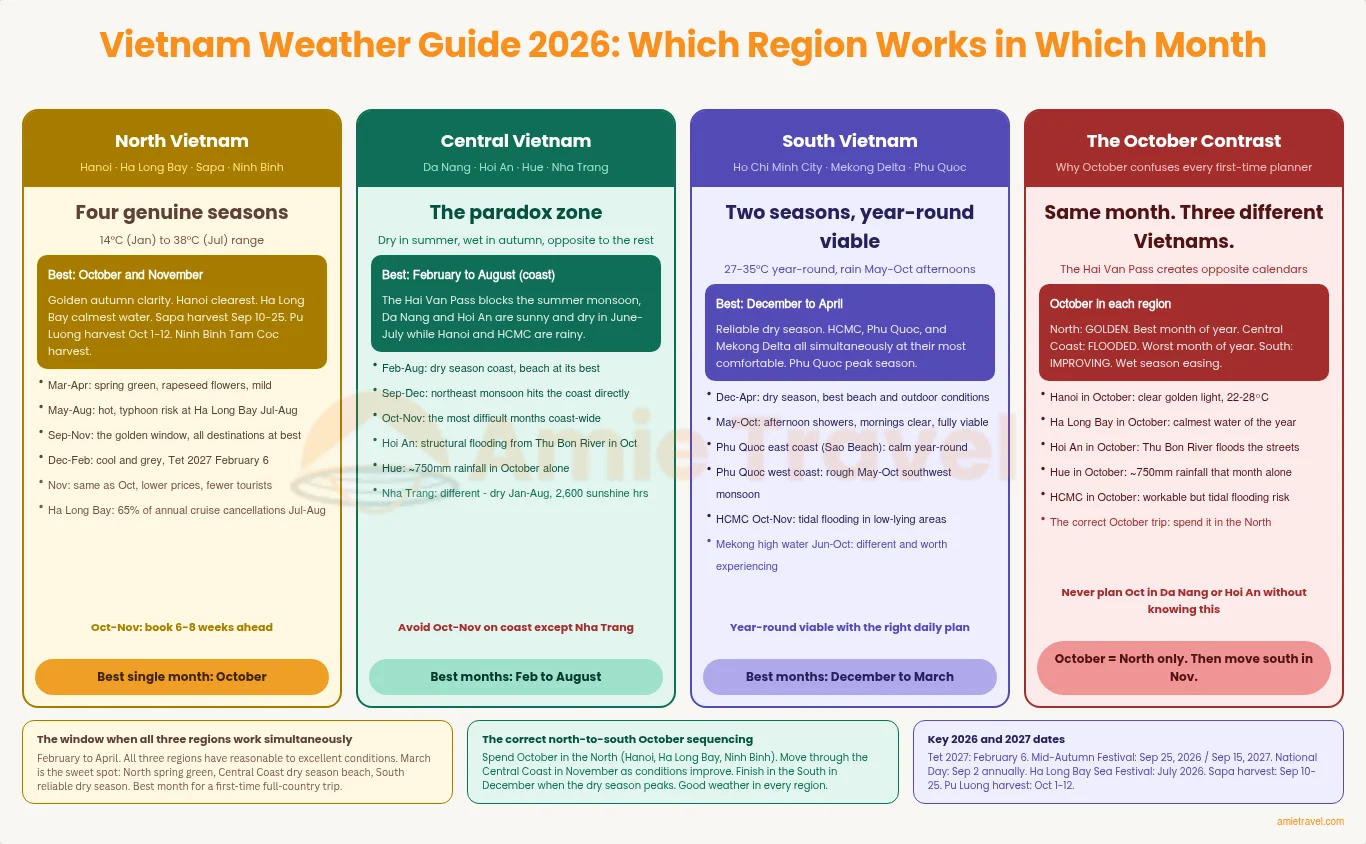
One sentence that summarizes the entire pattern: the Hai Van Pass is the reason Da Nang is sunny in July and flooded in October, while Hanoi is flooded in July and golden in October.
Understanding this, everything else in Vietnam weather planning makes sense.
North Vietnam by season: Four windows and when to use each
North Vietnam has four genuine seasons, which is unusual in Southeast Asia and one of the reasons the region rewards repeat visitors. Each season produces a different landscape and a different version of the same destination.

The golden autumn (September to November)
October is the single best month to visit the North across all destinations simultaneously. Hanoi is at its clearest and most walkable, with low humidity and the specific golden light that makes the French colonial streets and the Hoan Kiem lakeside look their best. Ha Long Bay has its calmest water and clearest visibility of the year. Ninh Binh has the golden harvest in the Tam Coc valley. The individual harvest windows in the specific highland destinations run on slightly different schedules: Sapa’s main Muong Hoa Valley peaks September 10 to 25, Pu Luong’s golden harvest peaks October 1 to 12, and Ninh Binh’s Tam Coc harvest runs through late October.
November has almost identical weather to October with noticeably fewer tourists and lower prices. It is specifically the underrated month of the northern calendar.
The spring green (March to April)
March and April are the second-best window for the North. The fields are vivid green from the winter planting cycle. The rapeseed flowers bloom across the Ninh Binh valley in February and March. Sapa has its mirror terrace season in April and May when the flooded fields reflect the sky before the rice is planted. The temperatures are comfortable at 18 to 26 degrees. The one honest caveat: late February through early April can bring the nom, a specific grey damp humidity unique to northern Vietnam where moisture loads the air and overcast skies can last for days. It is not a reason to avoid spring. It is a reason to have accurate expectations.
The summer (May to August)
Hot and humid in Hanoi at 32 to 38 degrees with the urban heat island making street-level temperatures run 3 to 4 degrees above the forecast. Afternoon monsoon rain from July. Ha Long Bay carries typhoon risk from July through August, with approximately 65 percent of annual cruise cancellations falling in these two months. The upside: international tourist volumes at all major heritage sites are at their lowest, early morning visits before 9am give you the heritage sites almost to yourself, and prices run 25 to 30 percent below the October peak.
The winter (December to February)
Cold by Vietnamese standards at 14 to 20 degrees in Hanoi in January. Grey and often misty. The morning fog over the Hoan Kiem Lake citadel moat in January is atmospheric in a specific way that October clarity cannot produce. Sapa can have frost and occasional snow at altitude. The weeks before Tet in late January bring a specific festive energy to the whole region.
For the full detail on each northern destination, see our destination guides: Best Time to Visit Hanoi, Best Time to Visit Ha Long Bay, Best Time to Visit Sapa, Best Time to Visit Pu Luong, and Best Time to Visit Ninh Binh.
Central Vietnam by season: Paradox zone and what each city actually does
Central Vietnam is the region that most confuses first-time Vietnam planners, and the confusion almost always comes from assuming it follows the same weather pattern as the North or the South. It does not. The Hai Van Pass geography described above means the Central Coast has its dry season when everywhere else is wet, and its rainy season when everywhere else is dry.
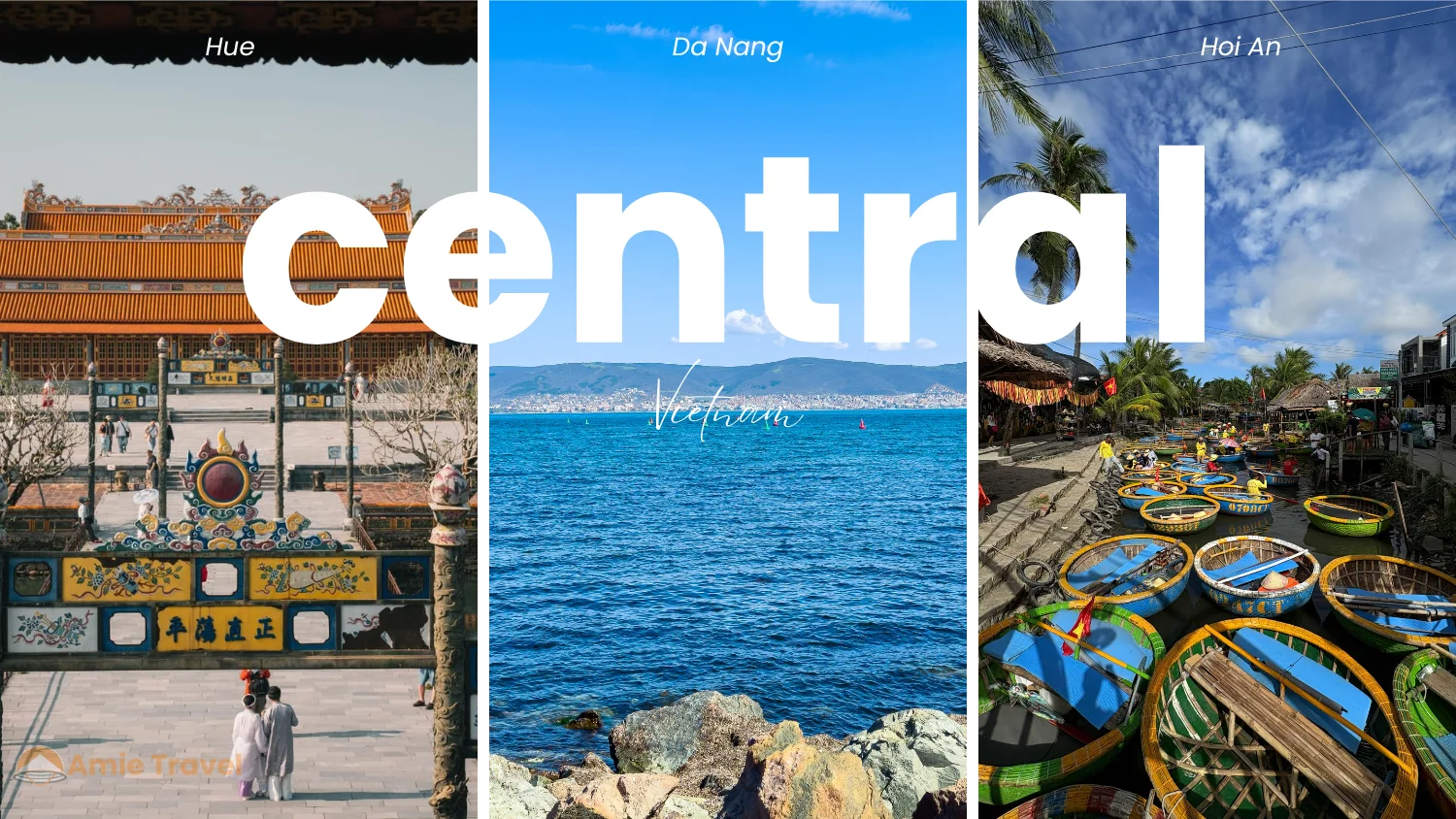
clear blue sky calm sea sunny
The dry season (February to August)
February to August is when the Central Coast is at its best for beach and outdoor tourism. The southwest monsoon’s foehn effect keeps the coast dry while the North and South are in their wet seasons. June and July in Da Nang and Hoi An are specifically excellent: beach-perfect conditions, clear skies, and warm seas while Hanoi is dealing with summer heat and rain.
The rainy season (September to December)
September brings the transition and October is the most difficult month coast-wide. The northeast monsoon arrives directly from the South China Sea with nothing to stop it. Da Nang as a modern city handles the rain better than Hoi An: urban drainage manages most downpours within an hour or two. Hoi An floods structurally when the Thu Bon River rises, backing up into the Ancient Town drainage from below. The flooding can reach ankle to knee depth on the worst October and November days and can last two to three days. Hue receives approximately 750mm of rain in October alone, the highest of any major Vietnamese city.
The sub-regional differences within Central Vietnam
Not all of Central Vietnam behaves identically in the rainy season and the differences matter for planning.
Da Nang is a modern city that keeps functioning in the rain. The Cham Museum, the Han River waterfront, the covered food markets, and the Ba Na Hills summit (which is frequently above the cloud line in sunshine when the coast is grey) all work in October.
Hoi An is the most flooding-prone of the Central Coast cities. The key accommodation decision in October: book in the new town area away from the Thu Bon River, not inside the Ancient Town. The Ancient Town is beautiful when flooded and specifically difficult to move through on the worst days.
Hue is the wettest city in Vietnam by total annual rainfall. Its outdoor heritage circuit including the Royal Tombs and the Perfume River cruise is the most weather-dependent experience on the Central Coast. Khai Dinh Tomb and the Museum of Royal Fine Arts work in rain. The outdoor cycling circuit between the tombs does not.
Nha Trang sits further south of the Hai Van Pass and has a different and shorter rainy season running September to December. Crucially, it has more sunshine hours than any other Vietnamese city at approximately 2,600 per year and its dry season runs January to August, longer than the coast above.
For the full detail, see our destination guides: Best Time to Visit Da Nang, Best Time to Visit Hoi An, Best Time to Visit Hue, Best Time to Visit Nha Trang, and our Central Vietnam in the Rainy Season guide.
South Vietnam by season: Two seasons, year-round viable, one structural note
South Vietnam has the simplest seasonal calendar of the three regions and is also the most misread because the rainy season here is consistently described in ways that make it sound worse than it is.
The dry season (November to April)
November to April is when the South is at its easiest. Temperatures sit comfortably at 27 to 32 degrees. Rain is minimal from December through February. The sky is reliably blue. Ho Chi Minh City, the Mekong Delta day trips, and Phu Quoc are all at their most comfortable and most photogenic simultaneously. This is the most popular window for international visitors and prices reflect it.

The rainy season (May to October)
The rainy season in southern Vietnam is not the sustained all-day rain that some parts of the world experience. The pattern on most days: a clear morning, afternoon showers arriving between 2 and 4pm lasting one to two hours, and then a cooler evening that is often the most comfortable time to be outside. Ho Chi Minh City is fully operational in the rainy season. The museums, the street food, the rooftop bars, the river tours in the morning: all of these work without adjustment.
The specific flooding note for Ho Chi Minh City
Ho Chi Minh City is sinking at an average rate of 1 to 2 centimeters per year in some areas, making the October and November tidal flooding worse independently of rainfall. The combination of peak rainy season and the highest tidal surges of the year creates flooding in specific low-lying areas including parts of former District 7 and the Saigon River waterfront in the south of the city. The District 1 and District 3 heritage areas where most international visitors spend their time are on higher ground and are generally unaffected.
The Phu Quoc east coast strategy
Phu Quoc in the rainy season requires knowing which coast to be on. The southwest monsoon swells hit the west coast (Long Beach, Sunset Town) and make it rough from May to October. The east coast beaches at Sao Beach and Khem Beach stay calm year-round because the island mass breaks the swell before it reaches the eastern shore. A traveler who books east coast accommodation in October has a working beach. A traveler who books west coast in October does not.
The Mekong Delta rainy season
The high-water Mekong Delta from June to October is a different and in some ways more interesting experience than the dry season version. The rice paddies flood, the floating markets ride higher with more produce, and the landscape from the boat has a cinematic quality that the low-water delta cannot produce. For travelers specifically interested in the Mekong as a working agricultural landscape, the rainy season is not a drawback.
For the full detail, see our destination guides: Best Time to Visit Ho Chi Minh City and Best Time to Visit Phu Quoc.
Vietnam month by month: Which region works when
This is the planning tool at the center of this guide. Each month maps which part of Vietnam is at its best, which part to approach with caution, and which trip type the month specifically suits.
January North: cool and grey at 14 to 20 degrees in Hanoi. Atmospheric for the morning mist experiences. Not for outdoor day trips requiring clear weather. Central Coast: Nha Trang excellent (driest month at 15mm). Da Nang and Hoi An entering their dry season. South: dry season peak, HCMC and Phu Quoc both excellent. Verdict: the best month to be in Nha Trang or Phu Quoc. Pre-Tet preparation building toward February.
February The one month when all three regions are simultaneously reasonable to excellent. North: dry season establishing, Tet 2027 February 6. Central Coast: dry and increasingly warm. South: dry season peak. Verdict: the best single month for a first-time visitor covering the whole country. Pre-Tet energy if your dates fall in late January to early February.
March North: spring green arriving, rapeseed flowers in Ninh Binh, nom humidity possible. Central Coast: Da Nang, Hoi An, Hue all in their dry season. South: dry season continuing. Verdict: strong all-round month. Comfortable across all three regions with the one caveat of potential grey drizzle in the North.
April North: warm and mostly clear, some heat building toward summer. Central Coast: excellent, Nha Trang diving visibility approaching peak. South: dry season tail end, still very good. Verdict: the last reliably comfortable month across all three regions before the North goes into summer heat.
May North: summer heat beginning in Hanoi. Central Coast: still in dry season, Da Nang and Hoi An beaches excellent. Nha Trang diving peak. South: rainy season beginning with afternoon showers, mornings still clear. Verdict: the month to be on the Central Coast beaches or in Nha Trang for diving.
June North: summer fully established, hot and humid in Hanoi. Central Coast: Da Nang and Hoi An at their sunny dry season best while the North and South are wet. Nha Trang peak diving visibility. South: wet season pattern established, functional with the right daily rhythm. Verdict: the best month to be in Da Nang and Hoi An specifically.
July North: peak summer heat, Ha Long Bay typhoon risk beginning, heritage sites excellent before 9am. Central Coast: Da Nang and Hoi An still dry and sunny. Nha Trang-Khanh Hoa Sea Festival July 20 to 26. South: wet season continuing, afternoon rain pattern. Verdict: Central Coast beaches at their best while everywhere else requires management.
August North: peak summer heat continues, Ha Long Bay typhoon risk highest. Central Coast: last full dry season month for Da Nang and Hoi An before the autumn rain. Nha Trang peak domestic season. South: Vu Lan Festival August 27, HCMC wet season continuing. Verdict: last chance for the Central Coast beaches before the rainy season arrives.
September North: transition to autumn beginning from late September, Sapa harvest opening September 10 to 25. Central Coast: rain arriving, the transition month. Cautious about Da Nang and Hoi An from mid-September. Nha Trang rain beginning. South: wet season continuing, HCMC functional. Verdict: position yourself in the North for the Sapa harvest and the beginning of the golden autumn.
October North: the best month for the entire northern circuit. Hanoi at its clearest and most walkable. Ha Long Bay calmest water of the year. Ninh Binh Tam Coc harvest. Pu Luong golden harvest October 1 to 12. Central Coast: the most difficult month coast-wide. Da Nang, Hoi An, Hue all at their wettest. South: HCMC workable with the right plan, highest tidal flooding risk. Phu Quoc east coast fully accessible. Verdict: the North is unmissable in October. Minimize or skip the Central Coast between Da Nang and Hue.
November North: still excellent, temperatures cooling toward winter, slightly fewer tourists than October, lower prices. South: dry season arriving, HCMC and Phu Quoc improving rapidly. Central Coast: still wet early November, improving from mid-month. Nha Trang: the wettest month of its calendar, avoid for beach. Verdict: the ideal month for a South Vietnam trip. The North is still very good. Central Coast in transition.
The 4 most common Vietnam trip itineraries and when they work best
This is the most commercially specific section in this guide. It maps the four trip structures that Amie Travel travelers most commonly plan and gives the specific seasonal guidance for each.
Itinerary 1: North to South (the full country, 2 to 3 weeks)
Covering Hanoi, Ha Long Bay, Hue, Da Nang, Hoi An, and Ho Chi Minh City in sequence.
Best timing: The February to April window is the most reliable because all three regions have reasonable to excellent conditions simultaneously. March is specifically the sweet spot: the North is clear and comfortable, the Central Coast is in its prime dry season, and the South is still in dry season before the April heat builds.
The October trap: Many travelers book a north to south trip with October dates because they have read that October is the best month for Vietnam. October is the best month for the North. It is the worst month for the Central Coast. A traveler who starts in Hanoi in October (excellent), moves south through Da Nang and Hoi An in mid-October (flooding risk), and arrives in HCMC in late October (improving but still wet) has planned an itinerary that starts brilliantly and becomes progressively more difficult.
The correct October sequencing: spend October in the North (Hanoi, Ha Long Bay, Ninh Binh), move through the Central Coast in November when conditions are improving and prices are still near October lows, and arrive in HCMC and Phu Quoc in December when the South is at its best. This gives you excellent conditions in every region.
Itinerary 2: North Vietnam only (1 to 2 weeks)
Hanoi, Ha Long Bay, Sapa or Pu Luong, Ninh Binh.
Best timing: October when all four destinations are simultaneously at their annual best. The October-November window gives the harvest at Sapa or Pu Luong, the golden Ha Long Bay cruise conditions, Ninh Binh at its most photogenic, and Hanoi at its clearest. November has almost identical conditions at lower prices and with fewer tourists.
Second best: March to April for the spring green and the rapeseed flower season in Ninh Binh.
See our 7-Day North Vietnam Tour: Hanoi, Ha Long Bay, Sapa and Fansipan for a northern circuit timed around the optimal seasonal window.
Itinerary 3: Central Vietnam and South (2 weeks)
Da Nang, Hoi An, Hue, then HCMC and Phu Quoc.
Best timing: February to April when the Central Coast is in its dry season and the South is at its best simultaneously. The circuit works cleanly with good conditions at both ends.
November and December also works well for this specific format: the Central Coast is transitioning back to dry season from mid-November, and the South is entering its peak dry season window. Prices at both ends are at or near their annual lows.
See our 12-Day Vietnam Honeymoon Tour for a Central and South Vietnam circuit in the optimal seasonal window.
Itinerary 4: Beach-focused South (1 week)
Nha Trang, Phu Quoc, HCMC as a base.
Best timing: December to March when all three are simultaneously in their best dry season conditions. Nha Trang is at its driest (February averages only 15mm), Phu Quoc west coast is calm and crystal clear, and HCMC is pleasant for day trips to the Mekong Delta and Cu Chi Tunnels.
For the Da Lat and Nha Trang combination, January to March is the optimal window: the highland cool of Da Lat at 15 to 22 degrees contrasting with the coastal warmth of Nha Trang at 24 to 27 degrees in a single 6-day circuit.
See our 6-Day Da Lat and Nha Trang Mountain and Beach Tour for the full highland-to-coast circuit.