Pu Luong 2026 at a glance
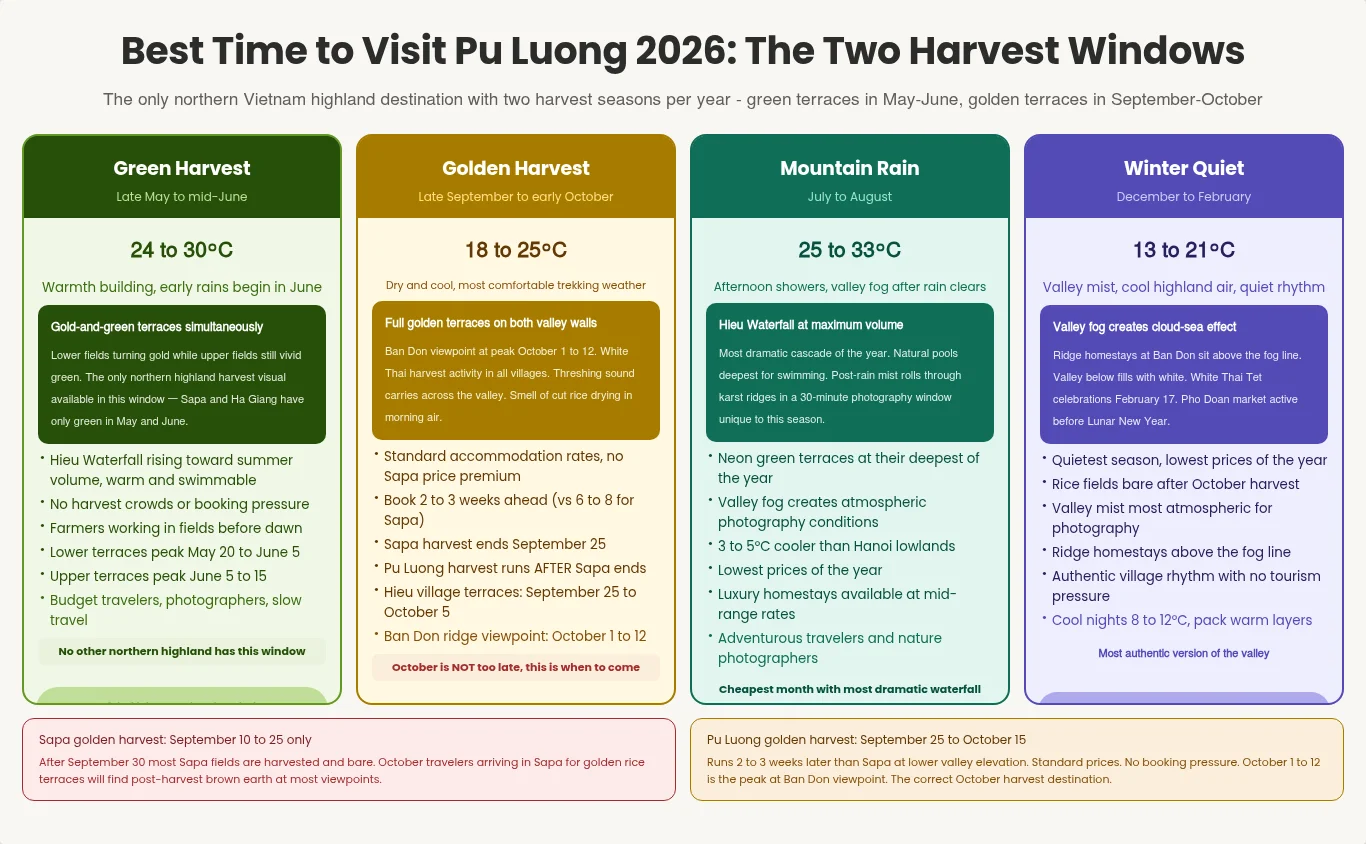
- Green Harvest season (late May to mid-June): First rice crop of the year. Lower terraces turning gold while upper fields are still vivid green. Hieu Waterfall rising toward summer volume. Pleasant temperatures. No harvest crowds. The only northern highland destination with a harvest visual in this window.
- Mountain rain season (July to August): Hieu Waterfall at maximum volume and most dramatic for swimming. Valley fog rolling through the limestone ridges after afternoon showers. Lowest prices of the year. Best for waterfall and lush green photography.
- Golden Harvest season (late September to early October): Second rice crop. Full golden terraces on both valley walls. Ban Don viewpoint at its most photographed. Cool temperatures of 18 to 25 degrees. Better availability and lower prices than Sapa in the exact same window.
- Winter quiet season (December to February): Valley mist and cool highland air at 13 to 20 degrees. White Thai community Tet preparations in February. Pho Doan market before the Lunar New Year. The quietest and most authentic version of the valley.
Key planning note: If your Sapa dates fall after September 25 and you came for golden harvest, Pu Luong is the correct October alternative. The second harvest runs one to two weeks later than Sapa at Pu Luong’s lower valley elevation.
The double harvest logic: Why Pu Luong is unique in Northern Vietnam
Most highland destinations in northern Vietnam grow one rice crop per year. The single harvest window drives almost all highland tourism from mid-September through mid-October. Pu Luong works on a completely different agricultural calendar.
The valley sits at a lower elevation than Sapa (800 to 1,000 meters versus Sapa’s 1,500 meters) on a limestone karst mountain system. The lower elevation and the valley’s particular sun exposure and water channel management allow White Thai and Muong farmers to cultivate two full rice crops per year. The first crop is planted in winter and harvested in late May and early June. The second crop is planted in summer and harvested in late September and early October.
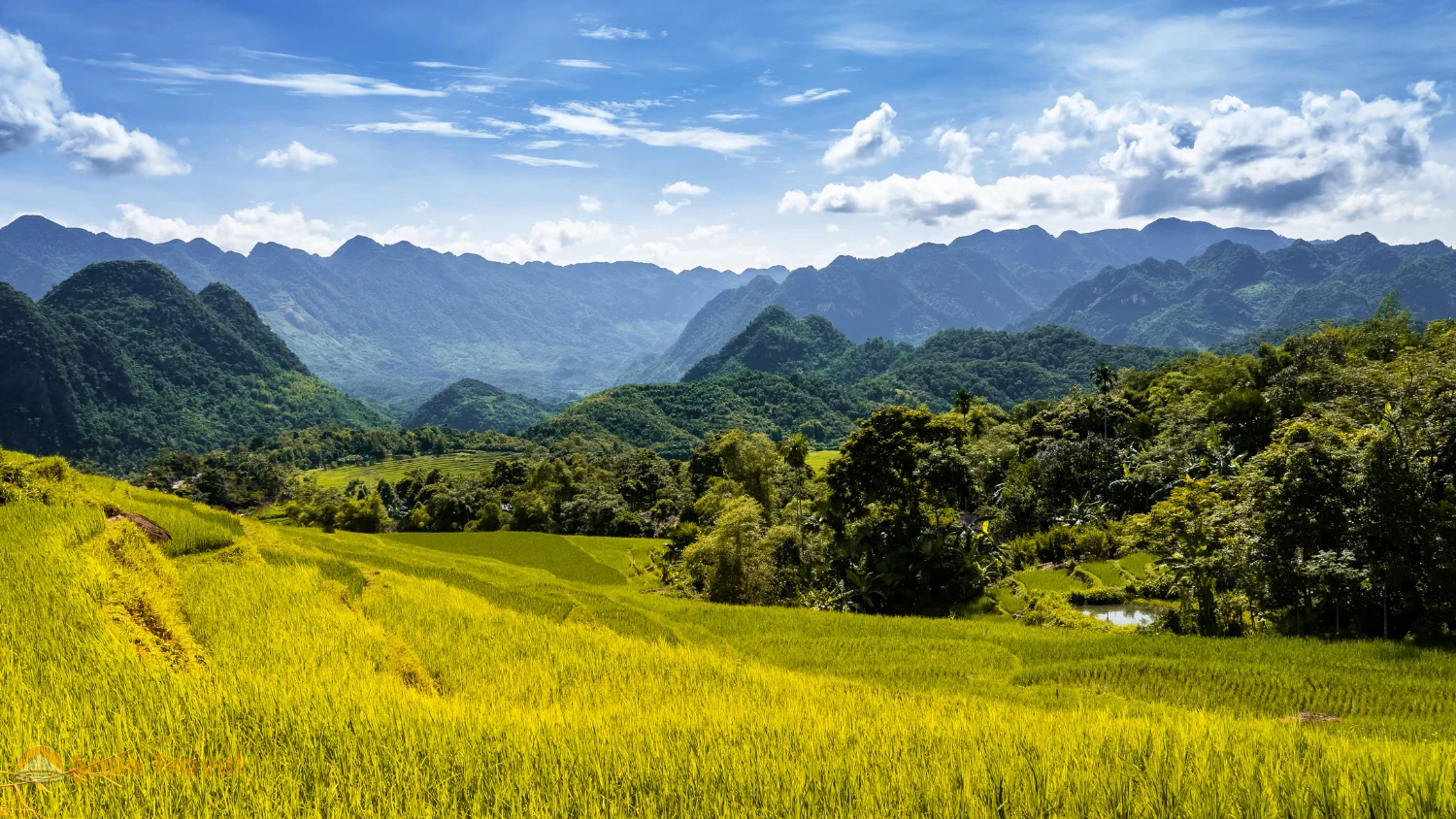
The first harvest (late May to mid-June)
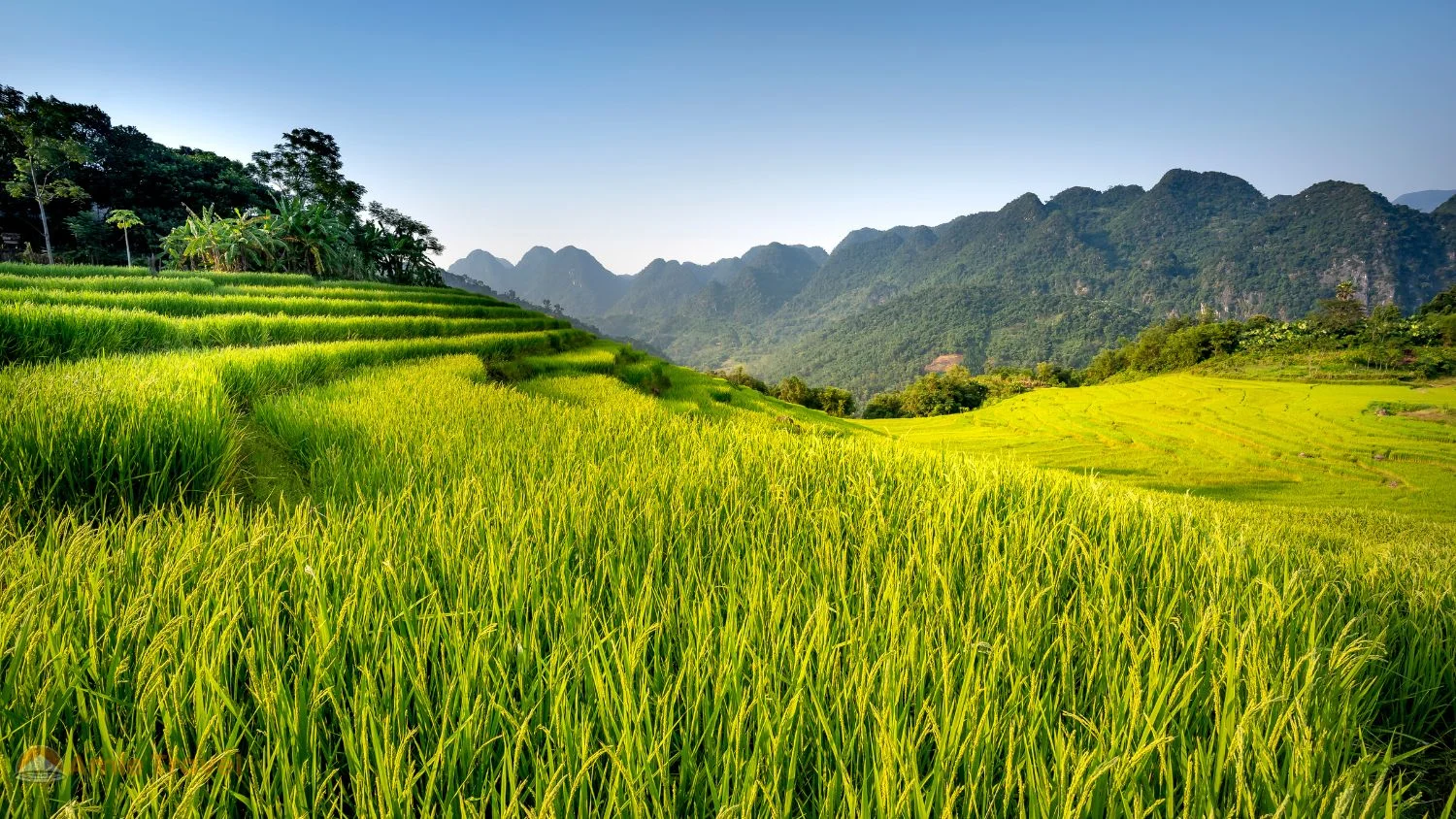
The first harvest catches most international travelers completely off guard because no other northern highland destination offers it. In late May, Pu Luong’s lower terraces are already turning from green to gold while the upper fields are still a vivid electric green. The two colors exist simultaneously in the same valley: lower fields gold and upper fields green, in a layered visual that Sapa in May, Ha Giang in May, and Mu Cang Chai in May cannot produce. All of those destinations have only young green rice shoots in this window.
The farmers harvest the first crop by hand in the early morning before the heat builds. By 6am most farming families are already in the fields. By 8am they return home for breakfast. By late morning the full valley heat arrives and the fields go still. For travelers staying in a Ban Don or Kho Muong homestay in late May, waking before dawn and walking the terrace paths while harvest activity fills the valley around you is an experience available nowhere else in northern Vietnam at this time of year.
Specific timing: the lower elevation terraces in Hieu village and the Kho Muong valley floor peak first, around May 20 to June 5. The higher terraces on the Ban Don ridge peak slightly later, June 5 to 15.
The second harvest (late September to early October)
The second harvest is the one most travelers come for. The full golden terrace season in Pu Luong runs from approximately September 25 through October 15, peaking around October 1 to 10. This runs one to two weeks later than the Sapa harvest at the main Muong Hoa Valley viewpoints, which peaks September 10 to 25.
This timing difference is the most commercially useful information in this article for travelers whose dates fall in early October. A traveler who misses the Sapa golden harvest because their flights arrive on October 1 can find the harvest still running at full gold in Pu Luong. The Ban Don viewpoint above the valley catches the second harvest at peak from late September through mid-October with none of the booking pressure that Sapa and Mu Cang Chai carry in the same window. Pu Luong homestays in October are available at standard rates with bookings made 2 to 3 weeks ahead versus the 6 to 8 weeks that Sapa requires.
Specific timing: the Hieu village terraces peak around September 25 to October 5. The Ban Don viewpoint above Kho Muong peaks around October 1 to 12. The higher ridge terraces above Ban Hang peak slightly later, October 5 to 15.
The Sapa comparison in plain terms
If you want the golden harvest and your dates fall before September 25: go to Sapa. The harvest peak is earlier there and the landscape at Muong Hoa Valley is extraordinary.
If you want the golden harvest and your dates fall after September 25: come to Pu Luong. The harvest runs later here and the valley is available without the Sapa booking pressure and price premium.
If you want a harvest visual in late May or June when every other northern highland destination has only green: come to Pu Luong. There is no other option.
See our Pu Luong Tours and Travel Guide for October and May harvest booking and the specific Ban Don viewpoint route details.
The four seasonal windows: Which Pu Luong are you coming for
The Green Harvest window (late May to mid-June)
Late May and early June in Pu Luong is the most underwritten window in all of northern Vietnam travel content. Temperatures run at 24 to 30 degrees during the day with cooler evenings in the valley. The first harvest is underway at the lower elevation terraces. The upper fields above Ban Don are still vivid green from the young second-crop rice. Hieu Waterfall is rising toward summer volume as the early rains begin in June, making it swimmable and increasingly dramatic.
The valley in late May has a quality that the September crowds cannot replicate: the farmers are working but the international tourists have not yet arrived. A traveler staying in a Ban Don homestay in late May shares the valley with working agricultural families rather than weekend tour groups from Hanoi. The morning walk from Ban Don down through the terraces to Kho Muong in late May, with harvest gold on the lower fields and dew still on the upper green terraces, is an experience with almost no international travel coverage.
What to pack: light breathable fabrics for 28 to 30 degree daytime temperatures. A light waterproof layer for occasional afternoon showers increasing through June. Waterproof trail shoes for terrace paths damp with morning dew. Swimwear for Hieu Waterfall which is warm enough in late May for comfortable swimming.
The mountain rain window (July to August)
July and August in Pu Luong are the months most travel guides describe as something to avoid and that experienced highland travelers describe as the most dramatically beautiful. The valley receives consistent afternoon rain. The rice terraces turn the deepest green they reach at any point in the year. The young rice of the second crop covers the valley in a saturated green that photographers specifically target.
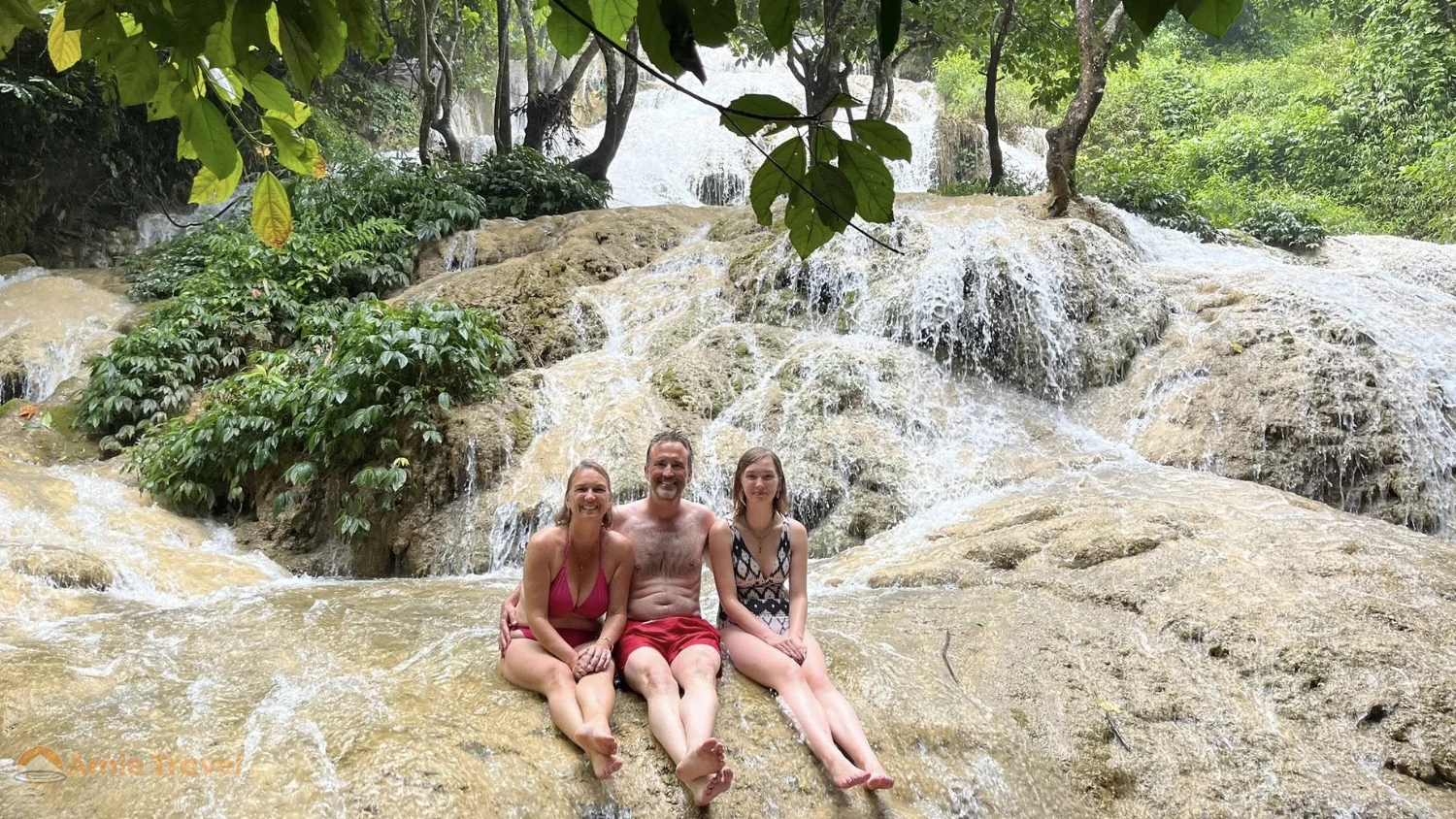
Hieu Waterfall in July and August is at maximum volume. The fall, which originates from a rocky cave in the Pu Luong limestone mountains and cascades approximately 800 meters over multiple tiers, runs at full force from the summer rains. The natural pools at the base are at their deepest and the swimming experience is the most dramatic. In late afternoon after the daily rain shower clears, mist rises from the warmed limestone ridges and rolls through the lower valley in visible waves. This specific 30-minute post-rain mist window is one of the most atmospheric photography conditions Pu Luong produces in any season.
What to pack: a proper waterproof jacket, not a light rain layer. Quick-dry clothing throughout. Waterproof boots with grip. Swimwear for Hieu Waterfall. A dry bag for camera equipment. Insect repellent for homestay evenings.
The Golden Harvest window (late September to early October)
This is the window most international travelers target. The second rice crop ripens from late September and the Ban Don viewpoint above the valley catches the full golden terrace view across both valley walls simultaneously at peak from approximately October 1 to 12.
White Thai families work the fields together during harvest week. The threshing sound carries across the valley from the hand-operated threshing machines at the terrace edges. Rice bundles hang on wooden frames along the terrace walls to dry. The smell of cut rice drying in the October morning air is specific to this moment and disappears completely when the harvest ends. At 18 to 25 degrees, October is the most comfortable temperature for walking that the valley produces.
The practical advantage over Sapa in this window: no booking pressure. Lao Chai and Ta Van in Sapa require bookings 6 to 8 weeks ahead with prices at a 30 to 50 percent premium. Ban Don and Kho Muong homestays in Pu Luong in October are available at standard rates with bookings made 2 to 3 weeks ahead. The valley trekking routes in October carry a fraction of the weekend tour group traffic of the Sapa circuit.
What to pack: light layers for cool mornings at 15 to 18 degrees warming to 22 to 25 degrees by midday. A packable fleece for evening temperature drops at the homestay. Waterproof trail shoes for the terrace paths between Ban Don and Kho Muong. A camera with a wide-angle lens for the Ban Don viewpoint panorama.
The winter quiet window (December to February)
December to February in Pu Luong is cold by Vietnamese highland standards: 13 to 20 degrees during the day and dropping to 8 to 12 degrees at night. The rice fields are bare after the October harvest. The valley is quiet in a way that no other season produces. The farming families are in a rest period between harvests. The weekend tour groups from Hanoi are not coming in the cold months. The valley fog that sits in the lower terraces in December and January gives Pu Luong a specific misty character.
The White Thai community Tet preparations begin in late January with traditional food preparation, sticky rice cake making, and family visits between villages. Pho Doan market in Lung Niem commune, Ba Thuoc district, is most atmospheric in the weeks before Tet when Thai, Muong, and Kinh families trade local products in preparation for the Lunar New Year. Tet 2026 falls on February 17. Travelers in Pu Luong in the two weeks before February 17 find a valley preparing for the most important event in the agricultural community’s year.
What to pack: a proper warm jacket. Thermal base layers for nights at 8 to 10 degrees. Waterproof boots. A hat and gloves for early morning walks in January. The cold in Pu Luong is genuine highland cold.
The practical reality of mountain living in Pu Luong
Pu Luong is not a resort destination with predictable daily schedules. It is a working valley with a limestone mountain microclimate that behaves differently from anywhere else in northern Vietnam. Understanding these realities before arrival makes the difference between a trip that feels authentic and one that feels frustrating.
The valley humidity and mountain fog
The limestone karst geology of Pu Luong creates a specific microclimate that most guides do not explain. The valley sits in a bowl formed by two parallel limestone ridges. After rain or in the cooler months, cold mountain air sinks quickly from the ridges to the valley floor and meets the warmer humid air sitting over the rice fields. The result is a dense valley fog that can develop in under 30 minutes and reduces visibility across the terraces to near zero.
This fog dissipates faster than it arrives. A clear morning can go to complete fog and return to clear within 90 minutes. The practical implication: early morning walks before 7am typically catch the valley before the fog sets. Late morning from 9am onward, after the fog burns off, gives the clearest terrace views. The afternoon window after 4pm, when the cooling air begins the fog cycle again, gives the most dramatic atmospheric photography. For travelers who position themselves on the Ban Don ridge above the fog line, the view of white fog filling the valley below with the surrounding karst peaks emerging above it is one of the specific Pu Luong experiences that cannot be replicated elsewhere.
The summer humidity from June through August adds a physical dimension. Cotton clothing absorbs this humidity and stays wet against the skin all day. Moisture-wicking synthetic or merino wool fabrics dry faster and are significantly more comfortable for valley walking in these months.
Valley floor versus ridge homestays
Pu Luong has two main accommodation zones with genuinely different experiences.
Ban Don and the ridge homestays sit above the valley floor at higher elevation with panoramic terrace views. The morning fog rolls below these homestays in winter and spring, creating the cloud-sea effect from above. These are the most photographed homestay positions in Pu Luong. The walk down from the ridge to the valley villages takes 20 to 40 minutes and requires the same walk back up.
Kho Muong and Hieu village homestays sit on the valley floor closer to the waterfall and the stream channel. The views are less panoramic but the immersion in daily village life is more immediate. The waterfall is accessible on foot from Hieu village in 15 minutes. The farming activity visible at dawn from these homestays is more intimate than the ridge view.
For first-time visitors: one night on the ridge at Ban Don for the panoramic view and one night on the valley floor at Kho Muong or Hieu for village immersion is the most complete two-night structure available in Pu Luong.
Kho Muong Cave in the dry season
Kho Muong Cave, also called Hang Doi, is a limestone cave system inside the Pu Luong Nature Reserve accessible via a trail from Kho Muong village. The dry season from October to April gives the best trail access conditions. The rainy season from June to September can make the approach path slippery and difficult. For travelers in Pu Luong in the dry season with a half-day spare, the cave adds a geological dimension that the terrace trekking alone does not provide.
Packing for Pu Luong regardless of season
Waterproof trail shoes with real ankle support are the single most important item for any Pu Luong visit at any time of year. The terrace paths between villages are narrow, often covered with wet grass or damp earth, and involve stream crossings on stepping stones. Standard trainers are inadequate.
Cotton clothing is a problem in June, July, and August when the valley humidity is high. Quick-dry fabrics make the difference between a comfortable walking day and an exhausting one. In the cool months from November through March, a proper warm layer for evenings is essential. The temperature in the Pu Luong valley at night in January at 8 to 10 degrees feels colder than the number suggests because the valley humidity amplifies the chill.
Is Pu Luong harder to trek than Sapa? The honest comparison
The honest answer is: different, not harder or easier.
Sapa trekking is a mountain rhythm. The main routes involve significant elevation gain and loss. The Lao Chai to Ta Van route descends 600 meters and climbs back up. The Fansipan summit trail gains over 1,600 meters. The physical demand is about sustained vertical movement through mountain terrain.
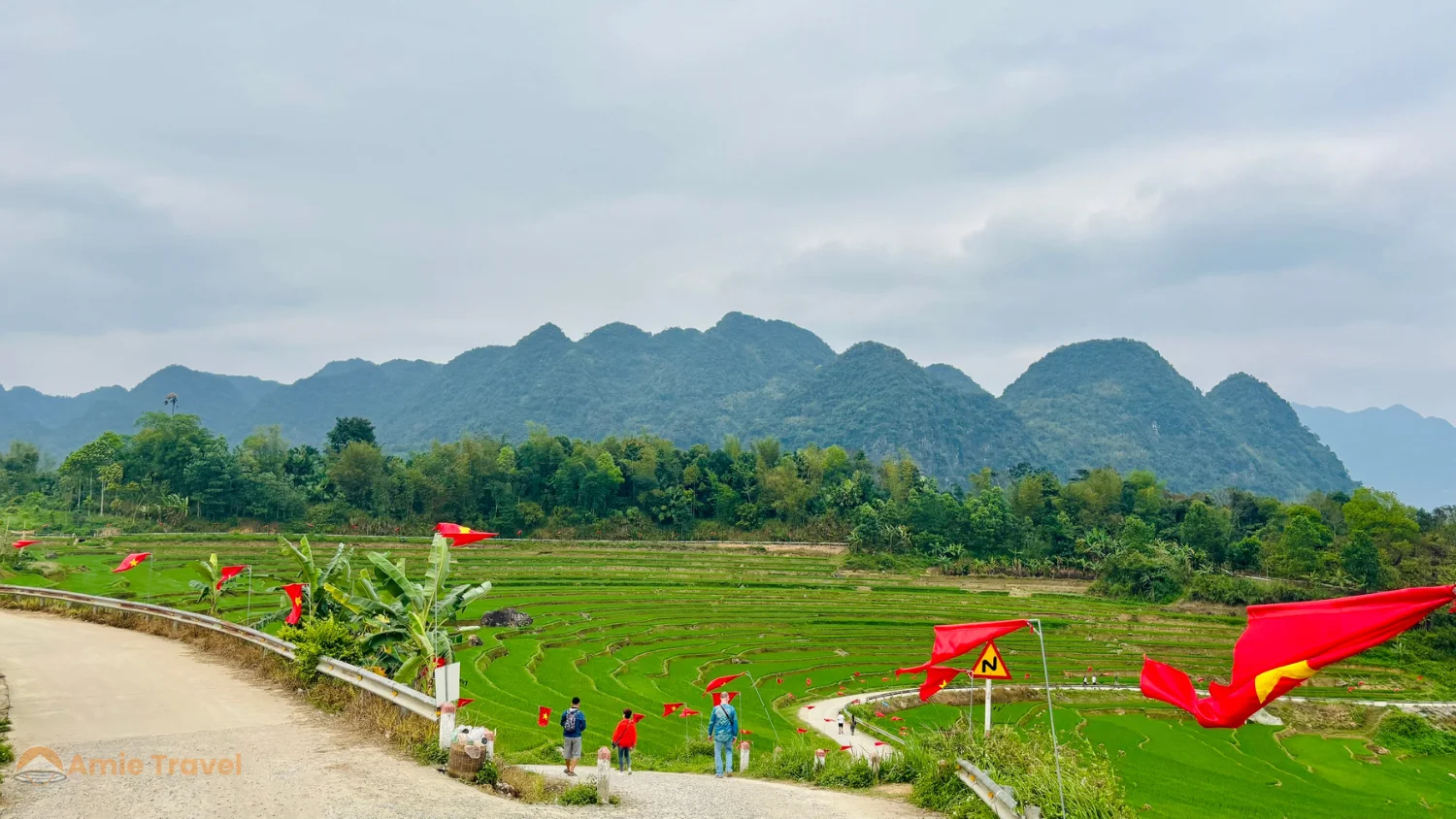
Pu Luong trekking is a valley rhythm. The main routes move along the valley contours between villages on broadly the same general elevation level. The walk from Ban Don down through Kho Muong to Hieu village loses approximately 200 to 300 meters over 8 to 10 kilometres. It is not flat but it is not the sustained elevation work of Sapa. The physical demand in Pu Luong is about distance and path conditions rather than vertical gain. Most travelers who would find the main Sapa routes too demanding physically find Pu Luong valley routes fully accessible.
The main routes by season
Ban Don to Kho Muong (the culture route): Distance: 8 to 10 kilometres one way. Elevation change: moderate descent. Best in: October to May when the terrace views are defined and the path is dry. What you see: the Ban Don panoramic viewpoint, the terraced valley descent, White Thai village life in Kho Muong, the Cham waterwheel at the valley floor.
Hieu village to Hieu Waterfall (the nature route): Distance: 3 to 5 kilometres return. Elevation change: gentle. Best in: June to September when the waterfall is at full volume and swimming pools are deep. What you see: the approach stream walk, the lower waterfall pools, the cave entrance at the waterfall source, the Hieu village White Thai community.
The Ban Don ridge viewpoint loop (the photography route): Distance: 4 to 6 kilometres from Ban Don. Elevation change: moderate, ridge-level. Best in: October to May for clear terrace views. Any season for fog and mist photography. What you see: panoramic valley views from above, both terrace walls simultaneously, the surrounding limestone karst ridges.
The weekday rule
Pu Luong is within a 4-hour drive of Hanoi. This proximity means weekend visitors from the capital fill the popular homestays and trekking routes from Friday evening through Sunday. The main Ban Don viewpoint on a Saturday morning in October has multiple group visits arriving simultaneously. The valley on a Wednesday morning in the same month is often completely quiet by 7am.
If your itinerary has any flexibility, arrive on Sunday evening when the weekend groups are leaving and begin the main routes on Monday morning. Tuesday, Wednesday, and Thursday mornings in Pu Luong give you the terrace walks and valley paths in a quiet that the weekend cannot offer regardless of season.
The Pu Luong pivot: How to build it into your 2026 itinerary
Pu Luong works best as part of a northern Vietnam circuit. Understanding where it fits in the broader itinerary makes the logistics simple and the experience more complete.
The natural circuit from Hanoi
Pu Luong sits 4 to 4.5 hours southwest of Hanoi by private car. The most natural circuits pair Pu Luong with either Ninh Binh or Mai Chau as a connecting stop.
Hanoi to Ninh Binh to Pu Luong: This is the most popular combination. Ninh Binh offers boat tours through limestone karst scenery at Trang An, which is geologically related to the Pu Luong limestone system. Arriving in Pu Luong from Ninh Binh gives a natural visual progression from open karst water landscapes to enclosed karst valley terraces. The total circuit from Hanoi covers two distinct versions of northern limestone scenery without retracing any road.
Hanoi to Mai Chau to Pu Luong: The more culturally connected combination. Both destinations have White Thai communities and similar agricultural rhythms. One hour separates them by road. Arriving in Pu Luong from Mai Chau gives an immediate comparison between two White Thai valleys that deepens the understanding of both.
Minimum nights: two is the floor, three is right
Two nights in Pu Luong covers the valley at a functional level: one morning on the Ban Don ridge viewpoint, one afternoon at Hieu Waterfall, one village walk between Kho Muong and Hieu. This is the minimum that makes the 4-hour drive from Hanoi worthwhile.
Three nights allows the split-base approach: one night on the ridge at Ban Don for the panoramic terrace view and two nights on the valley floor at Kho Muong or Hieu for village immersion and waterfall access. Three nights also gives the itinerary room to absorb one afternoon of rain without losing the key experiences. For travelers specifically targeting the harvest windows in late May or October, three nights is strongly recommended to be there across both the early morning light and the midday harvest activity.
When Pu Luong replaces Sapa in the October itinerary
For travelers with October dates and a golden harvest as the goal, Pu Luong is the most practical Sapa replacement. The drive time from Hanoi is shorter (4 hours versus 5 to 6 hours to Sapa). The booking pressure is lower. The prices are standard. The harvest at Pu Luong runs one to two weeks later than Sapa, meaning October 1 to 15 in Pu Luong delivers what September 10 to 25 delivers in Sapa.
For travelers with late May or early June dates, Pu Luong is the only northern highland destination delivering a harvest visual. Sapa in late May has only green. Ha Giang in late May has only green. Pu Luong in late May has gold and green simultaneously.
See our Pu Luong Tours and Travel Guide for specific homestay recommendations and valley route details.
See our Vietnam Adventure Tours for full northern Vietnam circuits that include Pu Luong.
Pu Luong weather month by month
January: 13 to 20 degrees, cool and misty, valley fog common in mornings. The rice fields are bare after the October harvest. Pho Doan market active with pre-Tet preparations in Lung Niem commune. The quietest month for tourism with the most authentic daily village life visible. Verdict: winter quiet and cultural immersion. Not for harvest or waterfall photography.
February: 14 to 21 degrees, Tet celebrations in the White Thai villages. Tet 2026 falls on February 17. The valley has a festive energy in the two weeks before Tet with traditional food preparation and family visits between villages. Some homestays close for the holiday week itself. Verdict: cultural experience and Tet highland atmosphere. Book well ahead for the Tet window.
March: 16 to 24 degrees, cool and pleasant, humidity beginning to build from mid-month. The rice transplanting season begins as farmers prepare the terraces for the first crop. Good for trekking with comfortable temperatures and drying trails. Verdict: active spring preparation energy, good trekking conditions, no harvest color yet.
April: 18 to 26 degrees, warm and clear, occasional afternoon showers beginning. The first crop young rice growing in the flooded terraces. The valley is green and the water channels are full, creating mirror reflection conditions if you catch the right early morning. Hieu Waterfall beginning to rise as April showers add to the flow. Verdict: mirror terrace potential, green valley, waterfall rising.
May: 22 to 30 degrees, first harvest beginning at lower elevation terraces from mid to late month. The gold-and-green simultaneous harvest visual available from approximately May 20 onward. Upper terraces still green while lower fields turn gold. Hieu Waterfall warm and swimmable. Farmers working before dawn in the fields. Verdict: the green harvest window opening. One of the two best months for unique photography in Pu Luong.
June: 24 to 32 degrees, first harvest completing at upper elevations in early June. Summer rain beginning from mid-June. Hieu Waterfall rising toward summer volume. The valley transitions from gold-and-green to deep green over the course of the month. Verdict: end of first harvest and beginning of lush green season. Good for waterfall swimming.
July: 25 to 33 degrees, consistent afternoon rain, valley fog after showers, Hieu Waterfall at near-peak volume. The rice terraces at maximum green depth. The hot lowland summer makes the Pu Luong valley at 24 to 28 degrees feel noticeably cool by comparison. Lowest international tourist numbers of the year. Verdict: dramatic waterfall, neon green terraces, valley atmosphere. For adventurous travelers who embrace the rain rhythm.
August: 24 to 33 degrees, heaviest rainfall of the year, Hieu Waterfall at peak volume, trails wet and requiring proper footwear. The valley is at its most lush. Late August the lower terrace fields begin changing color as the second crop approaches ripeness. Verdict: peak waterfall drama, most lush green, trail conditions require waterproof boots. Last chance for full summer waterfall before the harvest begins.
September: 20 to 28 degrees, rain decreasing, second harvest beginning from mid-month at lower elevation terraces. By September 25 the Hieu village and Kho Muong valley floor terraces are showing harvest gold. The Ban Don viewpoint begins catching the gold-and-green transition. Trail conditions improving as rains ease. Verdict: transition from lush green to harvest gold. Late September is the best single week if you can catch both colors simultaneously.
October: 18 to 25 degrees, dry and cool, second harvest peak October 1 to 15 at the Ban Don viewpoint. Full golden terraces on both valley walls. White Thai harvest activity in all villages. The most comfortable trekking temperatures of the year. Prices at standard rates unlike Sapa in the same window. Verdict: the golden harvest peak. One of the two best months for visiting Pu Luong.
November: 15 to 22 degrees, dry and clear, post-harvest quiet. The fields are bare after October. Valley mist in the mornings gives atmospheric photography. Prices low. Light crowds. Excellent trekking conditions with dry trails. Verdict: underrated month. Good trekking, valley atmosphere, low prices, the specific quiet of a community between harvests.
December: 13 to 20 degrees, cool and misty, winter character establishing. The valley is quiet in December in a way that is specific and intentional rather than empty. The limestone karst ridges catch the low winter light differently from any other season. Homestay fires and local food are the appeal. Verdict: winter quiet begins. For travelers who want the authentic valley rhythm without any harvest or tourism pressure.